Waite-Smith tarot (1909)
Ace of Cups
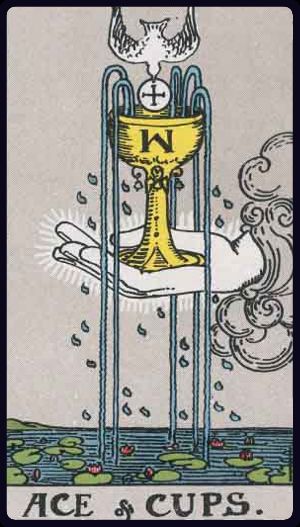
The Ace of Cups is a hand offering a cup from which a dove and streams pour. It is the card of the open heart — feeling, love and the offer of relationship.
Historical meanings below are quoted from A. E. Waite’s The Pictorial Key to the Tarot (1911). The language reflects that period; the following sections offer contemporary reflection.
Upright meaning
House of the true heart, joy, content, abode, nourishment, abundance, fertility; Holy Table, felicity hereof.
Reversed meaning
House of the false heart, mutation, instability, revolution.
Psychological themes
It represents the birth of feeling: affection, empathy, the wish to connect. It appears at a new emotional beginning. The cup overflows; the question is whether you will receive.
Traditional and cultural meanings
In the traditional reading the Ace is the house of the true heart, joy and abundance. It has long been read as nourishment and felicity, and by reversal as mutation and instability. The dove is the spirit that fills the cup.
Ways to reflect on this card
- If you feel: the heart opening, receive it.
- If you love: a beginning worth naming.
- If you close: the cup is offered anyway.
Questions for reflection
- What feeling am I refusing to let in?
- Where could I be more open?
- What would I give if the cup overflowed?
Common questions
What does the Ace of Cups mean?
New feeling and love — the open heart, affection, the start of a relationship or a creative outpouring.
Ace of Cups vs Ace of Wands?
Cups is feeling and connection; Wands is will and action. One is the warmth to feel, the other the fire to do.
Related cards
Explore the imagery in your own dream
Tarot offers one way to think about symbols. A dream interpretation also considers the events, feelings, and personal details you describe.
Interpret my dream Keep a dream journal Draw a three-card spread
Card readings here are a psychological and cultural lens, not a prediction and not medical or financial advice.