Waite-Smith tarot (1909)
Knight of Wands
The Knight of Wands rides hard, wand raised, a desert behind. He is the card of the dash — departure, heat, movement that does not look back.
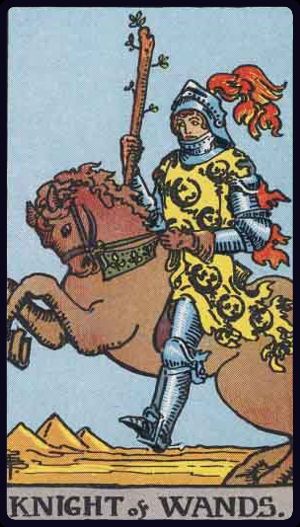
Historical meanings below are quoted from A. E. Waite’s The Pictorial Key to the Tarot (1911). The language reflects that period; the following sections offer contemporary reflection.
Upright meaning
Departure, absence, flight, emigration. A dark young man, friendly. Change of residence.
Reversed meaning
Rupture, division, interruption, discord.
Psychological themes
It represents action driven by impulse and warmth. He appears at a change of residence or a sudden leave-taking. The speed is his gift and his blindness.
Traditional and cultural meanings
In the traditional reading the Knight is departure, emigration and change of residence. It has long been read as a friendly dark young man, and by reversal as rupture, division and interruption. The horse does not stop to explain.
Ways to reflect on this card
- If you leave: the dash that clears the air.
- If you chase: heat, not always aim.
- If you bolt: will you return, or just flee?
Questions for reflection
- What am I rushing toward, or away from?
- Is this departure a choice or an escape?
- What will I miss by not looking back?
Common questions
What does the Knight of Wands mean?
Swift departure and fiery action — change of scene, a leap taken on impulse. Energy first, reflection later.
Knight vs Page of Wands?
The Page carries the message; the Knight acts on it at full speed. One is the spark, the other the charge.
Related cards
Explore the imagery in your own dream
Tarot offers one way to think about symbols. A dream interpretation also considers the events, feelings, and personal details you describe.
Interpret my dream Keep a dream journal Draw a three-card spread
Card readings here are a psychological and cultural lens, not a prediction and not medical or financial advice.