Waite-Smith tarot (1909)
Knight of Pentacles
The Knight of Pentacles rides a slow, steady horse, a coin in hand. He is the card of the dependable worker — patience, duty, the long steady push.
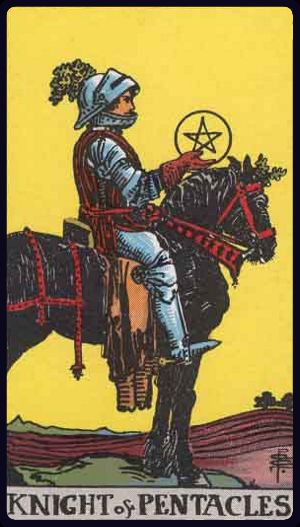
Historical meanings below are quoted from A. E. Waite’s The Pictorial Key to the Tarot (1911). The language reflects that period; the following sections offer contemporary reflection.
Upright meaning
Utility, serviceableness, interest, responsibility, rectitude-all on the normal and external plane.
Reversed meaning
inertia, idleness, repose of that kind, stagnation; also placidity, discouragement, carelessness.
Psychological themes
It represents grounded persistence: the willingness to go slow and finish. He appears when reliability matters more than speed. The horse is unhurried; the work gets done.
Traditional and cultural meanings
In the traditional reading the Knight is utility, serviceableness and responsibility. It has long been read as rectitude on the normal plane, and by reversal as inertia, stagnation and carelessness. The coin is carried; the field is worked.
Ways to reflect on this card
- If you work: the steady hand that finishes.
- If you stall: duty drifting into drift.
- If you plough: the slow that wins.
Questions for reflection
- Where is steady effort my advantage?
- Am I persistent or just stuck?
- What would patience actually deliver?
Common questions
What does the Knight of Pentacles mean?
Dependable, patient work — duty and the long steady push. Slow, but it arrives.
Knight vs Page of Pentacles?
The Page studies; the Knight applies the learning by working it. One begins, the other continues.
Related cards
Explore the imagery in your own dream
Tarot offers one way to think about symbols. A dream interpretation also considers the events, feelings, and personal details you describe.
Interpret my dream Keep a dream journal Draw a three-card spread
Card readings here are a psychological and cultural lens, not a prediction and not medical or financial advice.