Waite-Smith tarot (1909)
Nine of Swords
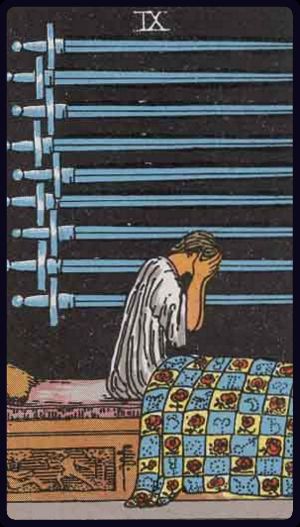
The Nine of Swords shows a figure in bed, head in hands, nine swords on the wall. It is the card of the sleepless worry — anxiety that grows in the dark.
Historical meanings below are quoted from A. E. Waite’s The Pictorial Key to the Tarot (1911). The language reflects that period; the following sections offer contemporary reflection.
Upright meaning
Death, failure, miscarriage, delay, deception, disappointment, despair.
Reversed meaning
Imprisonment, suspicion, doubt, reasonable fear, shame.
Psychological themes
It represents the mind's own torment: fear rehearsed until it feels real. It appears at insomnia of the spirit. The swords are on the wall, not in the body.
Traditional and cultural meanings
In the traditional reading the Nine is death, failure and despair. It has long been read as delay, deception and disappointment, and by reversal as imprisonment, doubt and shame. The worry is often larger than the cause.
Ways to reflect on this card
- If you dread: the fear bigger than the fact.
- If you wake: name it, it shrinks.
- If you spiral: the swords are on the wall.
Questions for reflection
- What am I fearing that has not happened?
- Is this anxiety or actual danger?
- What would ground me right now?
Common questions
Is the Nine of Swords the "worst" card?
It is acute anxiety and dread — often the mind magnifying fear at night. Painful, but the swords are on the wall, not in you.
Nine vs Eight of Swords?
The Eight is bound and blind; the Nine is awake in anguish. One is trapped, the other is tormented by thought.
Related cards
Explore the imagery in your own dream
Tarot offers one way to think about symbols. A dream interpretation also considers the events, feelings, and personal details you describe.
Interpret my dream Keep a dream journal Draw a three-card spread
Card readings here are a psychological and cultural lens, not a prediction and not medical or financial advice.