Waite-Smith tarot (1909)
Ten of Swords
The Ten of Swords shows a figure prone, ten swords in the back, a distant dawn. It is the card of the absolute low — the end of the worst, and the light after.
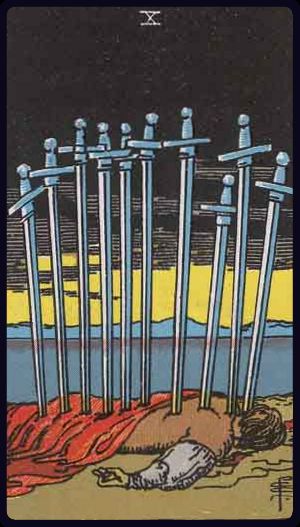
Historical meanings below are quoted from A. E. Waite’s The Pictorial Key to the Tarot (1911). The language reflects that period; the following sections offer contemporary reflection.
Upright meaning
Whatsoever is intimated by the design; also pain, affliction, tears, sadness, desolation. It is not especially a card of violent death.
Reversed meaning
Advantage, profit, success, favour, but none of these are permanent; also power and authority.
Psychological themes
It represents the rock bottom that is also a floor: nothing worse remains. It appears at the completion of suffering. The dawn is the promise the dark could not erase.
Traditional and cultural meanings
In the traditional reading the Ten is pain, affliction and desolation. It has long been read as not a card of violent death, and by reversal as advantage and favour that pass. The swords are spent; the morning comes.
Ways to reflect on this card
- If you hit bottom: it cannot go lower.
- If you end: the worst is complete.
- If you see dawn: this is the turning.
Questions for reflection
- What is finally over?
- Is this the lowest, or just low?
- What would beginning again require?
Common questions
Does the Ten of Swords mean death?
Almost never. It means the worst is complete — rock bottom, after which the only direction is up. The dawn is in the card.
Ten vs Three of Swords?
The Three is the heart pierced; the Ten is the ordeal finished. One is the wound, the other is the end of suffering.
Related cards
Explore the imagery in your own dream
Tarot offers one way to think about symbols. A dream interpretation also considers the events, feelings, and personal details you describe.
Interpret my dream Keep a dream journal Draw a three-card spread
Card readings here are a psychological and cultural lens, not a prediction and not medical or financial advice.