Waite-Smith tarot (1909)
Three of Pentacles
The Three of Pentacles shows a sculptor, a monk and a novice before a carved arch. It is the card of skilled work — craft honoured, the team that builds well.
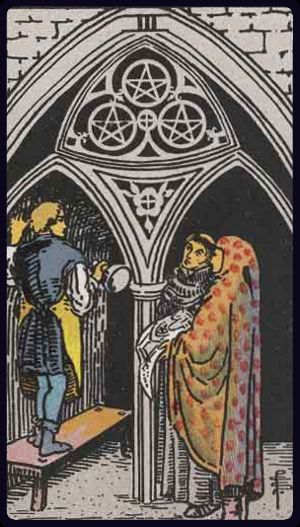
Historical meanings below are quoted from A. E. Waite’s The Pictorial Key to the Tarot (1911). The language reflects that period; the following sections offer contemporary reflection.
Upright meaning
Métier, trade, skilled labour; usually, however, regarded as a card of nobility, aristocracy, renown, glory.
Reversed meaning
Mediocrity, in work and otherwise, puerility, pettiness, weakness.
Psychological themes
It represents the satisfaction of competent making and good collaboration. It appears at a job done with care. The arch is raised by many hands.
Traditional and cultural meanings
In the traditional reading the Three is métier, trade and skilled labour. It has long been read as nobility, renown and glory, and by reversal as mediocrity and weakness. The work is seen; the craft is real.
Ways to reflect on this card
- If you build: the craft worth doing well.
- If you team: the hands that raise the arch.
- If you learn: the apprentice who watches.
Questions for reflection
- What work am I proud to make?
- Who helps me build, and do I credit them?
- Where is my craft being tested?
Common questions
What does the Three of Pentacles mean?
Skilled work and collaboration — craft honoured, a job built well with others. Competence made visible.
Three vs Eight of Pentacles?
The Three is the work raised with a team; the Eight is the solitary apprentice practising. One builds with others, the other alone.
Related cards
Explore the imagery in your own dream
Tarot offers one way to think about symbols. A dream interpretation also considers the events, feelings, and personal details you describe.
Interpret my dream Keep a dream journal Draw a three-card spread
Card readings here are a psychological and cultural lens, not a prediction and not medical or financial advice.