Waite-Smith tarot (1909)
Seven of Swords
The Seven of Swords shows a figure carrying five swords, leaving two behind. It is the card of the quiet exit — strategy, evasion, the plan that slips away.
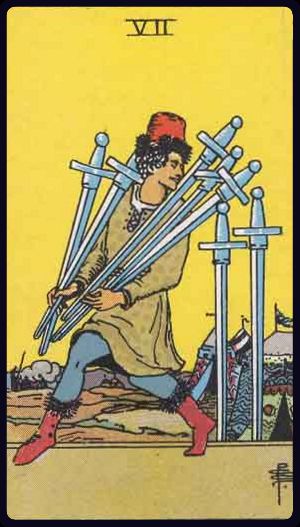
Historical meanings below are quoted from A. E. Waite’s The Pictorial Key to the Tarot (1911). The language reflects that period; the following sections offer contemporary reflection.
Upright meaning
Design, attempt, wish, hope, confidence; also quarrelling, a plan that may fail, annoyance. The design is uncertain in its import, because the significations are widely at variance with each other.
Reversed meaning
Good advice, counsel, instruction, slander, babbling.
Psychological themes
It represents the sideways move: getting what you can and leaving the rest. It appears when open fight is unwise. The shadow is deception dressed as cleverness.
Traditional and cultural meanings
In the traditional reading the Seven is design, attempt and hope. It has long been read as quarrelling and a plan that may fail, and by reversal as good advice, counsel and slander. The figure takes five; two are left as a tell.
Ways to reflect on this card
- If you scheme: the exit that saves you.
- If you steal: the cost of the sneak.
- If you advise: the counsel worth hearing.
Questions for reflection
- What am I quietly extracting?
- Is this strategy or dishonesty?
- What did I leave behind as a tell?
Common questions
What does the Seven of Swords mean?
A strategic withdrawal or evasion — getting what you can and slipping away. It can also warn of deceit.
Seven vs Five of Swords?
The Five wins by force and stain; the Seven wins by slipping out. One dominates, the other escapes.
Related cards
Explore the imagery in your own dream
Tarot offers one way to think about symbols. A dream interpretation also considers the events, feelings, and personal details you describe.
Interpret my dream Keep a dream journal Draw a three-card spread
Card readings here are a psychological and cultural lens, not a prediction and not medical or financial advice.