Waite-Smith tarot (1909)
King of Swords
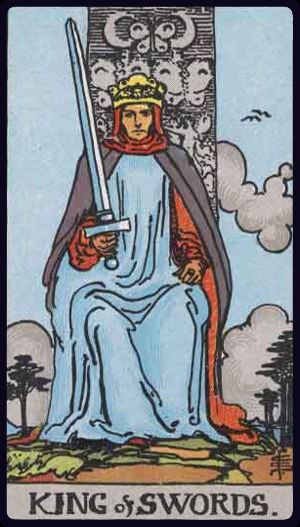
The King of Swords sits in judgment, a sword upright, a book in hand. He is the card of reasoned authority — the mind that decides by principle.
Historical meanings below are quoted from A. E. Waite’s The Pictorial Key to the Tarot (1911). The language reflects that period; the following sections offer contemporary reflection.
Upright meaning
Whatsoever arises out of the idea of judgment and all its connexions-power, command, authority, militant intelligence, law, offices of the crown, and so forth.
Reversed meaning
Cruelty, perversity, barbarity, perfidy, evil intention.
Psychological themes
It represents the disciplined intellect: fair, decisive, detached. He appears as the judge or as your own clear reasoning. His shadow is coldness that mistakes distance for wisdom.
Traditional and cultural meanings
In the traditional reading the King is judgment, power and militant intelligence. It has long been read as law and offices of the crown, and by reversal as cruelty, perversity and perfidy. The sword is upright; the book is the law.
Ways to reflect on this card
- If you decide: by principle, not mood.
- If you rule: the law that serves, not bends.
- If you chill: distance, not wisdom.
Questions for reflection
- Where should I decide by reason, not feeling?
- Am I just, or merely detached?
- What would a fair judge do here?
Common questions
What does the King of Swords mean?
Rational authority — a man (or energy) who judges by principle. Clear, fair, decisive intellect.
King vs Queen of Swords?
He rules by abstract law; she cuts from lived loss. Same suit, different source of the edge.
Related cards
Explore the imagery in your own dream
Tarot offers one way to think about symbols. A dream interpretation also considers the events, feelings, and personal details you describe.
Interpret my dream Keep a dream journal Draw a three-card spread
Card readings here are a psychological and cultural lens, not a prediction and not medical or financial advice.