Waite-Smith tarot (1909)
Death
Death rides through on a pale horse, a skeleton in armour, a bishop and a child in his path. It is the card of endings — and endings are how anything new begins.
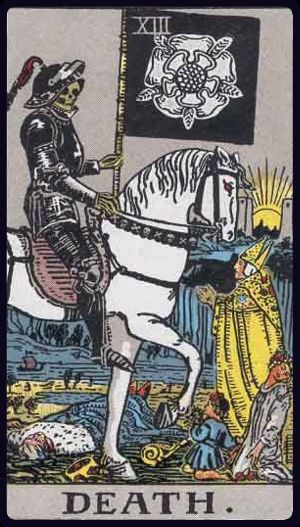
Historical meanings below are quoted from A. E. Waite’s The Pictorial Key to the Tarot (1911). The language reflects that period; the following sections offer contemporary reflection.
Upright meaning
End, mortality, destruction, corruption also, for a man, the loss of a benefactor for a woman, many contrarieties; for a maid, failure of marriage projects.
Reversed meaning
Inertia, sleep, lethargy, petrifaction, somnambulism; hope destroyed.
Psychological themes
He represents the psyche's need to finish what is over so something else can start. He appears at closure that has been postponed. His fear is mostly the name; the work is release.
Traditional and cultural meanings
In the traditional reading Death is end, mortality and transformation. It has long been read as corruption and conclusion, and by reversal as inertia, sleep and hope destroyed. The scythe clears; it does not merely cut down.
Ways to reflect on this card
- If something is over: let it end, and mean it.
- If you are afraid: the change is transition, not annihilation.
- If you are clinging: what dies now makes room for the next.
Questions for reflection
- What in your life has already ended that you refuse to bury?
- What would begin if this closed?
- Are you grieving, or merely postponing?
Common questions
Does the Death card mean someone will die?
Almost never, in practice. It means an ending and transformation — a chapter closing so another can open.
Why is it not frightening?
Because endings are natural. The card asks you to complete what is over rather than to fear the change itself.
Related cards
Explore the imagery in your own dream
Tarot offers one way to think about symbols. A dream interpretation also considers the events, feelings, and personal details you describe.
Interpret my dream Keep a dream journal Draw a three-card spread
Card readings here are a psychological and cultural lens, not a prediction and not medical or financial advice.