Waite-Smith tarot (1909)
Wheel Of Fortune
The Wheel of Fortune turns above, figures rising and falling with it. It is the card of cycles — fortune, timing and the turn that no one controls.
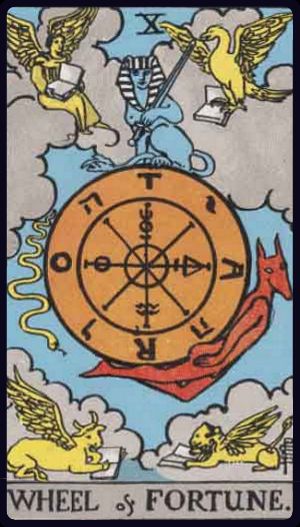
Historical meanings below are quoted from A. E. Waite’s The Pictorial Key to the Tarot (1911). The language reflects that period; the following sections offer contemporary reflection.
Upright meaning
Destiny, fortune, success, elevation, luck, felicity.
Reversed meaning
Increase, abundance, superfluity.
Psychological themes
It represents the part of life that is larger than the individual will. It appears at转折点 where luck, fate or circumstance shift. The lesson is to ride the turn without pretending you authored it.
Traditional and cultural meanings
In the traditional reading the Wheel is destiny, fortune and elevation. It has long been read as luck and felicity, and by reversal as increase and abundance. The wheel turns for all; what matters is the posture you keep on it.
Ways to reflect on this card
- If things are rising: enjoy it, and know it moves.
- If things are falling: this turn is not the whole story.
- If you feel stuck: the wheel is due; prepare, don't force.
Questions for reflection
- What in your life is turning that you cannot steer?
- Are you taking credit for luck, or learning from it?
- What would change if you trusted the cycle?
Common questions
Is the Wheel good or bad?
Neither fixed. It is change itself — elevation and decline in turn. The card counsels perspective across the whole rotation.
Does it mean fate is fixed?
No. It means timing and circumstance shift beyond your control; your part is how you meet the turn.
Related cards
Explore the imagery in your own dream
Tarot offers one way to think about symbols. A dream interpretation also considers the events, feelings, and personal details you describe.
Interpret my dream Keep a dream journal Draw a three-card spread
Card readings here are a psychological and cultural lens, not a prediction and not medical or financial advice.