Waite-Smith tarot (1909)
The Last Judgment
Judgement shows figures rising from coffins as an angel sounds the trumpet, water below. It is the card of reckoning and awakening — the call to account, and to rise.
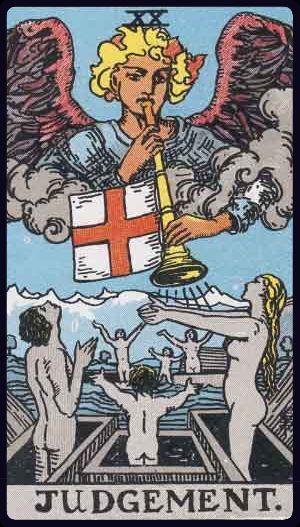
Historical meanings below are quoted from A. E. Waite’s The Pictorial Key to the Tarot (1911). The language reflects that period; the following sections offer contemporary reflection.
Upright meaning
Change of position, renewal, outcome. Another account specifies total loss though lawsuit.
Reversed meaning
Weakness, pusillanimity, simplicity; also deliberation, decision, sentence.
Psychological themes
It represents the moment of honest self-review and the choice to ascend. It appears at renewal after a long accounting. The trumpet is an invitation, not a threat.
Traditional and cultural meanings
In the traditional reading Judgement is change, renewal and outcome. It has long been read as a total reckoning, and by reversal as weakness, simplicity or deliberation. The call asks whether you will answer it.
Ways to reflect on this card
- If you are reviewing: the honest look that frees you.
- If you are called: a chance to rise, not to be judged.
- If you resist: the past you haven't absolved.
Questions for reflection
- What are you finally ready to account for?
- What old version of you is being called up?
- Are you answering the call, or avoiding it?
Common questions
Is Judgement about guilt?
No. It is awakening and renewal — the moment of clear self-accounting that lets you rise, not a sentencing.
Judgement vs the Lovers?
The Lovers choose at a fork; Judgement reviews the whole road and rises from it. One is the choice, the other the reckoning.
Related cards
Explore the imagery in your own dream
Tarot offers one way to think about symbols. A dream interpretation also considers the events, feelings, and personal details you describe.
Interpret my dream Keep a dream journal Draw a three-card spread
Card readings here are a psychological and cultural lens, not a prediction and not medical or financial advice.