Waite-Smith tarot (1909)
The Hierophant
The Hierophant sits between two pillars, handing down a taught tradition, two acolytes before him. He is the card of structured teaching and shared belief.
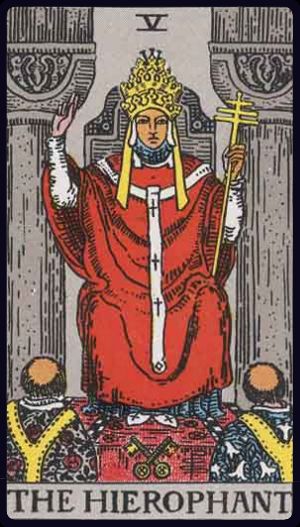
Historical meanings below are quoted from A. E. Waite’s The Pictorial Key to the Tarot (1911). The language reflects that period; the following sections offer contemporary reflection.
Upright meaning
Marriage, alliance, captivity, servitude; by another account, mercy and goodness; inspiration; the man to whom the Querent has recourse.
Reversed meaning
Society, good understanding, concord, overkindness, weakness.
Psychological themes
He stands for the part of you that learns from what came before — mentors, institutions, inherited wisdom. He appears when guidance or belonging to a tradition matters. His shadow is conformity that silences the individual.
Traditional and cultural meanings
In the traditional reading the Hierophant is alliance, doctrine and the teacher to whom one turns. He has long been read as marriage and mercy, and by reversal as over-kindness, weakness or mere agreement. He is the keeper of the approved way.
Ways to reflect on this card
- If you seek guidance: a teacher or tradition worth your trust.
- If you feel boxed in: borrowed beliefs you have not examined.
- If you are mentoring: the responsibility of passing something on.
Questions for reflection
- Whose teaching are you actually living by?
- Where do you conform without questioning?
- What would you want to pass on to someone younger?
Common questions
Is the Hierophant religious?
It points to structured belief and teaching of any kind — religious, scholarly or cultural. It is the card of the approved way, not one faith in particular.
Hierophant vs High Priestess?
She guards inner, unspeakable wisdom; he hands down the taught, shared tradition. Intuition versus institution.
Related cards
Explore the imagery in your own dream
Tarot offers one way to think about symbols. A dream interpretation also considers the events, feelings, and personal details you describe.
Interpret my dream Keep a dream journal Draw a three-card spread
Card readings here are a psychological and cultural lens, not a prediction and not medical or financial advice.