Waite-Smith tarot (1909)
The Fool
The Fool is card zero of the major arcana: a traveller at the edge of a cliff, a small bundle over one shoulder, a dog at his heels. It is the moment before the step — pure beginning, before consequence has a shape.
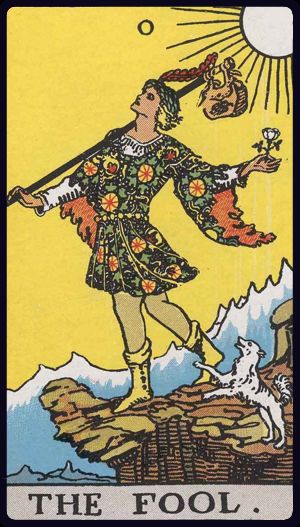
Historical meanings below are quoted from A. E. Waite’s The Pictorial Key to the Tarot (1911). The language reflects that period; the following sections offer contemporary reflection.
Upright meaning
Folly, mania, extravagance, intoxication, delirium, frenzy, bewrayment.
Reversed meaning
Negligence, absence, distribution, carelessness, apathy, nullity, vanity.
Psychological themes
In depth psychology the Fool stands for the spontaneous self, the part of you willing to begin without a map. It often appears when a new chapter is opening and the old calculations no longer apply. The risk it names is not recklessness for its own sake but the courage to be a beginner.
Traditional and cultural meanings
In the long tarot tradition the Fool is the unnumbered origin from which the whole journey spills out. Readers have long treated it as the soul setting out, innocent and unprotected, trusting the road to appear. It is read as auspicious at a start and as a quiet warning not to mistake inexperience for safety.
Ways to reflect on this card
- If the step feels free and unafraid: a genuine new beginning, taken on trust.
- If you feel pushed rather than drawn: a leap forced by circumstances you did not choose.
- If something is holding you back: the hesitation itself is the message — not every edge should be stepped off.
Questions for reflection
- What would you begin if you knew you could not fail?
- Are you stepping off because you chose to, or because you were pushed?
- What are you carrying that you no longer need?
Common questions
Is the Fool a bad card?
No. It is the card of beginnings. It can warn against naivety, but on its own it points to a fresh start taken on trust, not to harm.
Does the Fool mean I will be reckless?
Not necessarily. It names a willingness to begin without certainty. Whether that becomes courage or folly depends on what you step toward and what you leave behind.
Related cards
Explore the imagery in your own dream
Tarot offers one way to think about symbols. A dream interpretation also considers the events, feelings, and personal details you describe.
Interpret my dream Keep a dream journal Draw a three-card spread
Card readings here are a psychological and cultural lens, not a prediction and not medical or financial advice.